

5/20/2025
The automated factory: the future of industrial production
The manufacturing industry is entering a new era: the automated factory. A production model where advanced machines and software operate completely autonomously, reducing the need for human intervention and revolutionising the way products are made.
This change is no longer a futuristic possibility but a reality rapidly taking hold in many industries.
A new approach to production
The automatic factory is the most natural evolution of Industry 4.0. Thanks to the integration of artificial intelligence, robotics and advanced software, machines manage production autonomously, while operators are limited to monitoring and controlling the process. This means less tiring and risky work for operators and optimised resource management.
More and more companies are investing in technologies that digitise and automate production. Increasing market competitiveness requires companies to improve their efficiency and customer responsiveness. In this context, the automated factory is no longer a question of 'if', but of 'when’.
The technologies already exist and are increasingly accessible, offering unique opportunities for companies that want to improve their competitiveness. Investing in these solutions today means preparing for the future, ensuring more efficient, sustainable and state-of-the-art production.
The future of reinforcement lies in automation
The rebar industry is also experiencing a real revolution, adopting plants where machines operate autonomously, without the need for manual intervention by operators. Personnel are limited to supervising the process, without having to perform tiring or risky work. Wire is handled automatically, and workflows are managed by advanced software designed to reduce waste, cut costs, and optimise production and logistics.
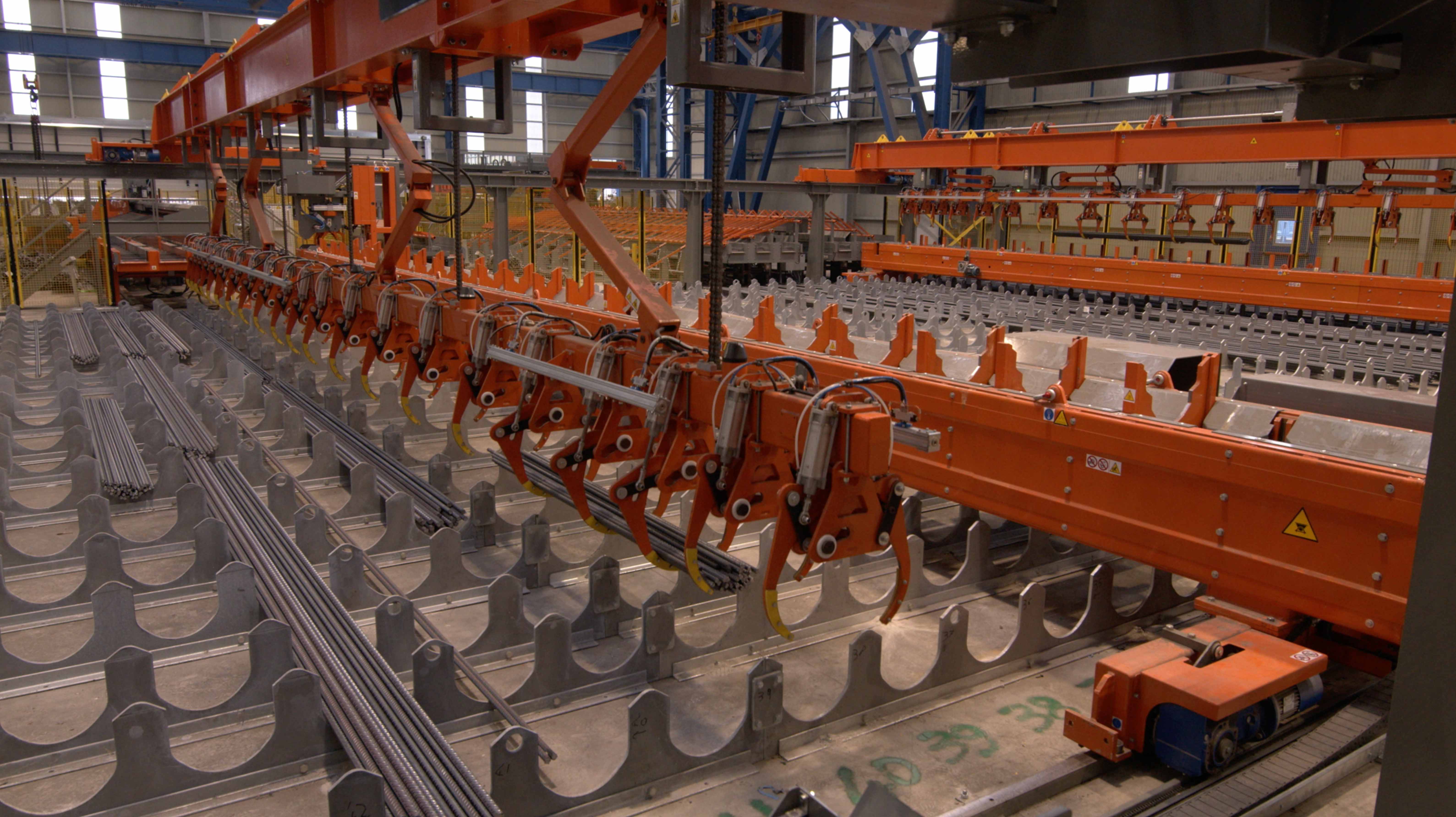
The market is changing: Towards total automation
Schnell has also been moving in this direction for some years now, designing machines that can achieve greater production efficiency, reduce material waste, reduce the need for skilled labour and improve working conditions. Furthermore, state-of-the-art software, such as OPTIFLOW, monitors the entire production process in real time, allowing critical issues to be identified and timely action to be taken to maximise efficiency.
Shaping and precast benefits
Automated Factory's key benefits:
1. Operational efficiency: automatic machines run without interruption, reducing downtime and increasing overall productivity.
2. Cost reduction: Less waste material and lower labour costs mean significant cost savings.
3. Work safety: Operators no longer have to perform strenuous or dangerous work, improving the quality of the working environment.
4. Production flexibility: Automated solutions can be customised according to different production requirements.
Tailor-made production technology
One of the key issues of the automated factory is its ability to adapt to different production requirements. Each company has specific processes that need to be optimised according to volumes, product types and internal logistics.
Automation solutions must, therefore, be customised to ensure maximum integration with existing systems and maximum plant performance.
The future of reinforcement is now
The adoption of the automated factory is not just a trend but a strategic necessity for all companies that want to remain competitive in an increasingly competitive market.
As an industry leader, Schnell is revolutionising the concept of industrial automation with its UN.O. programme, an ecosystem of integrated solutions that optimise the entire production process.
Schnell already has next-generation machines such as the Cutting Lines with Ground Buffer, the ROBOMASTER 60 UN.O. bending robot, the COMPASS 40 UN.O. radius bending system, the SENSO straightening system, the ROBOT APPS, the ABL automatic loaders, and the OPTIFLOW management software.
With these solutions, “UNMANNED” plants are already achievable.
Those who invest in automation today will be ready for the challenges of the future, securing a competitive advantage over their competitors. The time to act is now: the automated factory is the key to a more efficient, sustainable and innovative industry.
